
Research overview
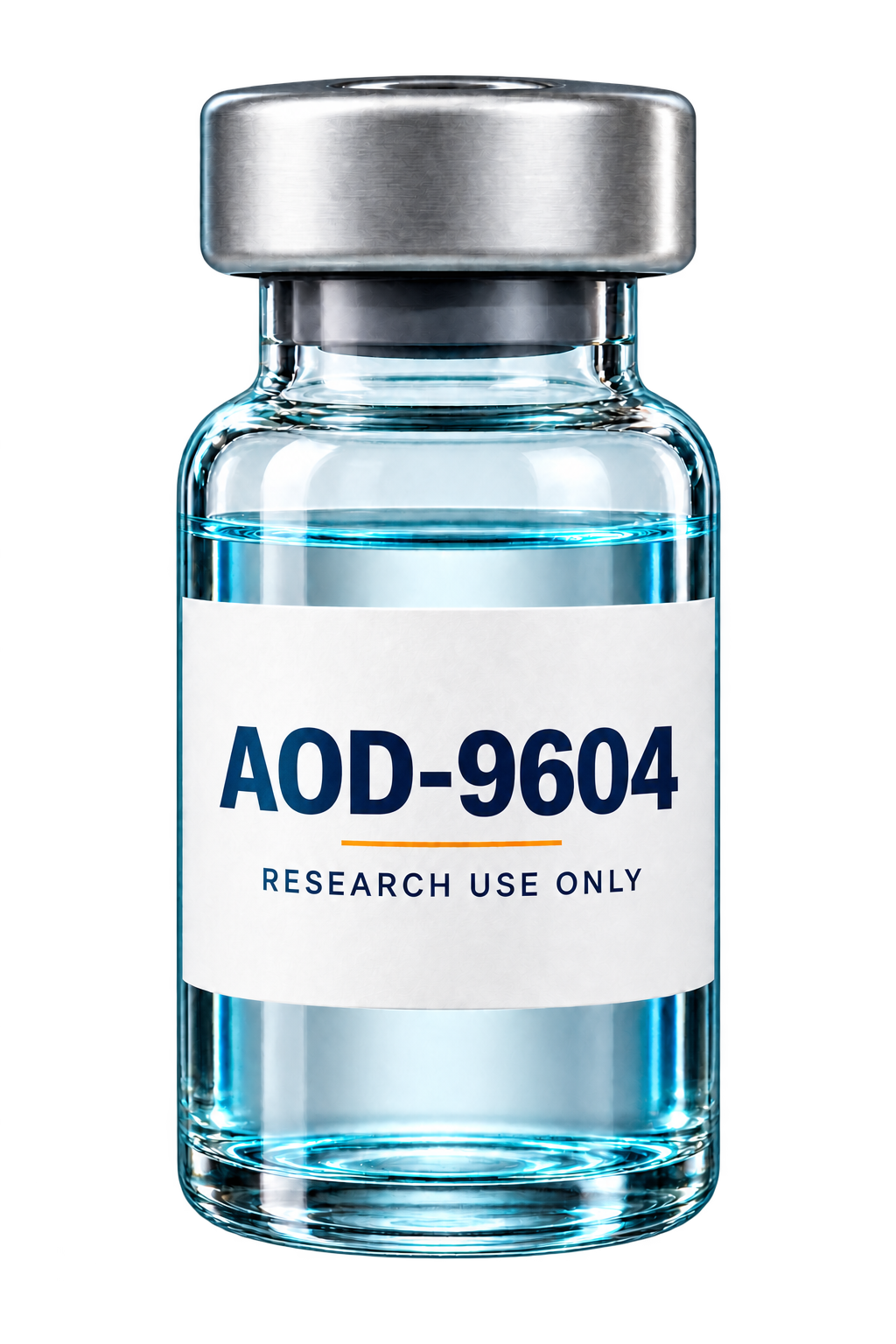
What is AOD-9604?
AOD-9604 is a synthetic modified fragment of human growth hormone, not the intact hormone. An analytical study identifies it as the 177–191 C-terminal fragment with an additional tyrosine at the N-terminus: a 16-residue peptide. It should not be conflated with an unmodified growth-hormone fragment, and results for the full hormone should not automatically be attributed to it.
What has research examined?
In one published mouse experiment, researchers compared AOD-9604 with intact human growth hormone and saline in obese and lean mice. AOD-9604 was associated with reduced weight gain in obese mice and increased fat-oxidation measures; cell assays did not show the same growth-hormone-receptor binding or proliferation as intact hormone. A separate mouse study examined lipid-metabolism measures and beta-adrenergic pathways. These animal findings do not establish a human weight-loss benefit. A sponsor-associated publication also summarized safety observations from six randomized, placebo-controlled human development trials; that analysis addresses studied formulations and conditions, not the identity, sterility, efficacy, or safety of a research product sold today.
Mouse metabolic effects do not establish human effectiveness. A pooled analysis of human trial safety data is not proof that a supplier’s research vial is safe or suitable for any use. FDA has noted limited safety-related information and potential immunogenicity and impurity-characterization concerns for compounded AOD-9604; reported serious adverse events have uncertain causality. This page does not establish product identity, preparation, dose, or appropriate use in people or animals.
Research references
- Increase of fat oxidation and weight loss in obese mice caused by chronic treatment with human growth hormone or a modified C-terminal fragmentInternational Journal of Obesity
- The effects of human GH and its lipolytic fragment (AOD9604) on lipid metabolism following chronic treatment in obese mice and beta(3)-AR knock-out miceEndocrinology
- Detection and in vitro metabolism of AOD9604Drug Testing and Analysis
- Safety and Tolerability of the Hexadecapeptide AOD9604 in HumansJournal of Endocrinology and Metabolism
- Certain Bulk Drug Substances for Use in Compounding that May Present Significant Safety RisksU.S. Food and Drug Administration
Calculation boundary
The calculator performs concentration arithmetic only when a user enters a mass and liquid volume. It does not verify identity, formulation, purity, sterility, stability, compatibility, biological-unit equivalence, or whether reconstitution applies to a particular product. Do not convert IU or other biological units to mg without an authoritative, exact-product relationship.