
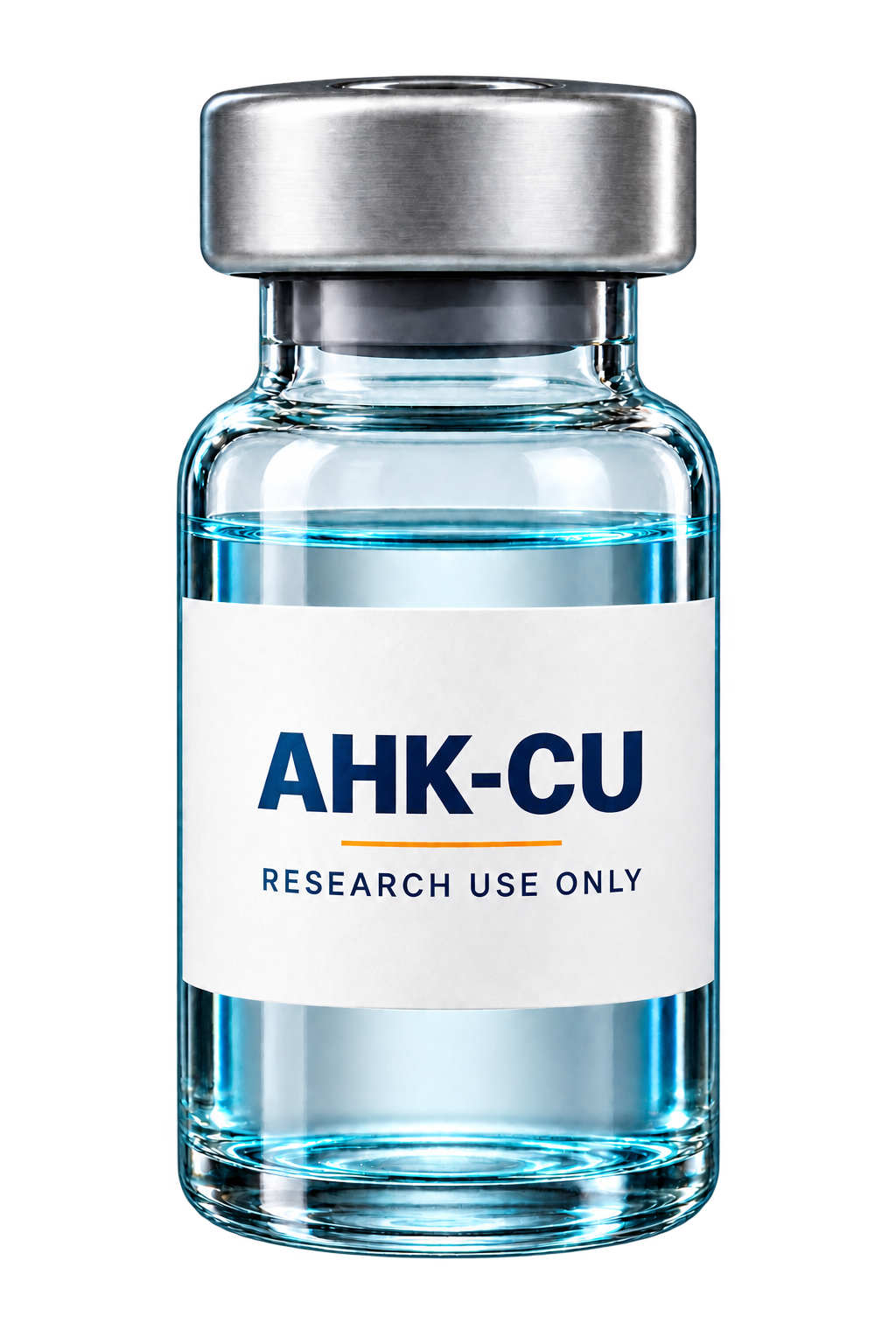
Research overview
What is AHK-Cu?
AHK-Cu is L-alanyl-L-histidyl-L-lysine complexed with copper(II). Its three-amino-acid sequence begins with alanine, which distinguishes it from the better-known GHK-Cu sequence that begins with glycine. Research suppliers may list both as copper peptides, but findings for one should not automatically be attributed to the other.
What has research examined?
The direct AHK-Cu literature is limited. A PubMed-indexed study evaluated cultured human hair follicles outside the body and cultured human dermal papilla cells. Within the tested laboratory conditions, researchers reported increased follicle elongation and dermal papilla cell proliferation. A measured reduction in apoptotic dermal papilla cells was not statistically significant, although several apoptosis-related protein markers changed.
This is a narrow laboratory evidence base, not a controlled clinical outcome in people. It does not establish product effectiveness, safety, preparation, dosing, or appropriate use in humans or animals.
Research references
- The effect of tripeptide-copper complex on human hair growth in vitroArchives of Pharmacal Research
Calculation boundary
The calculator performs concentration arithmetic only when a user enters a mass and liquid volume. It does not verify identity, formulation, purity, sterility, stability, compatibility, biological-unit equivalence, or whether reconstitution applies to a particular product. Do not convert IU or other biological units to mg without an authoritative, exact-product relationship.